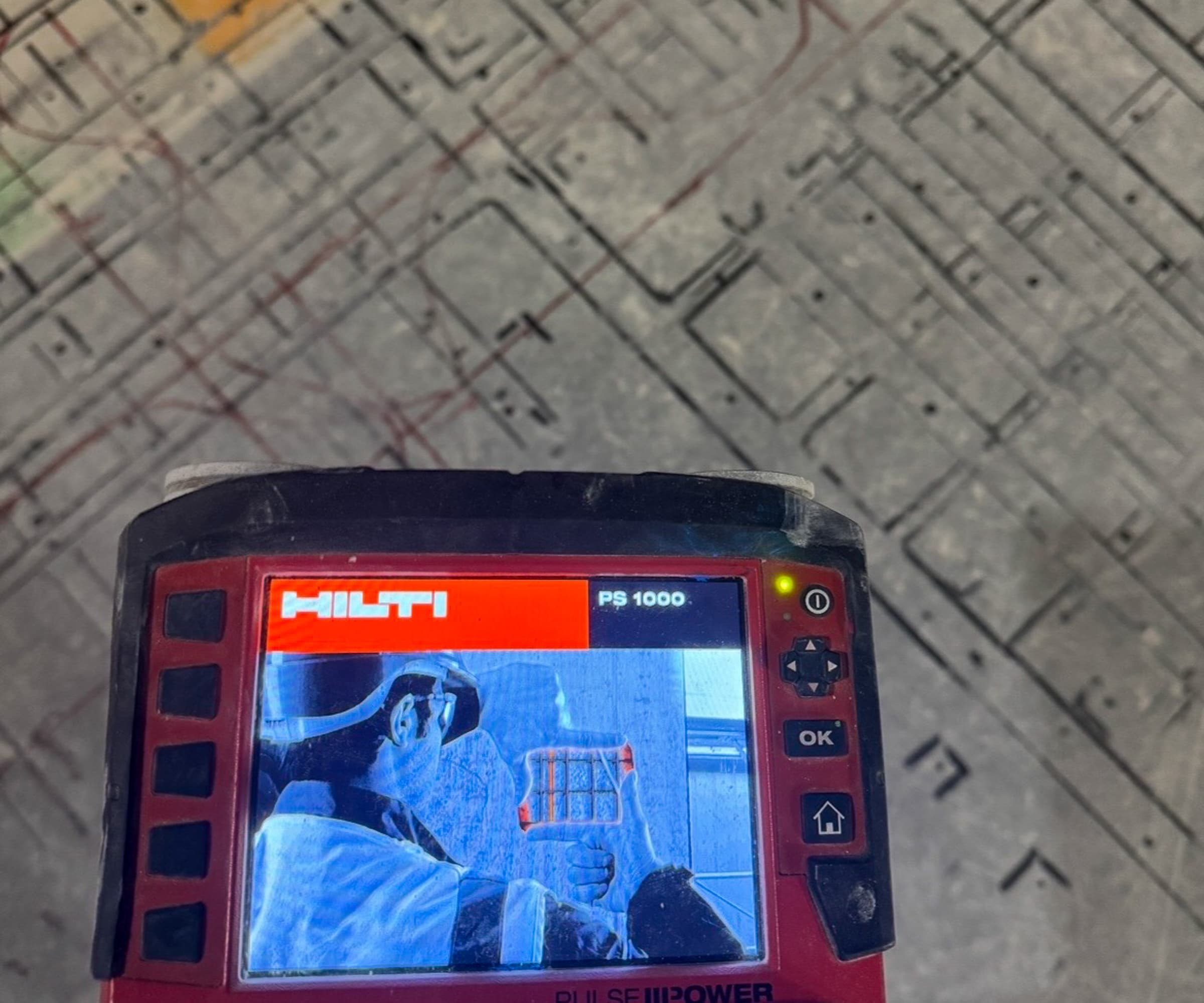
SIDE.ec provides field-focused GPR scanning services for construction teams planning core drilling concrete, saw cutting, wall sawing, renovations, MEP work and other work that may affect embedded systems.
Choose a service below or send us the project location and scan area. We can review the request and help determine the appropriate scanning scope.
01
GPR / Concrete / Tristate area
Concrete GPR scanning
Investigate accessible concrete before core drilling. SIDE.ec uses Ground Penetrating Radar to evaluate designated areas and mark relevant responses for field reference.
Planning a core drilling concrete?
Send the project address, scan area, coordinate core drilling locations and requested date.
Concrete GPR scanning is a non-destructive field method used to evaluate accessible concrete surfaces for changes and reflections that may correspond with reinforcement, conduits, pipes, post-tension components, voids or other embedded conditions. SIDE.ec scans the requested area in multiple directions when conditions allow, interprets the radar patterns and marks relevant findings on the surface.
Common applications
Core drilling
Saw cutting
Anchor installation
MEP penetrations
Renovation and retrofit work
Structural and slab investigation
Preconstruction field verification
What we may observe
Depending on the concrete, depth, orientation and site conditions, GPR may indicate reinforcement patterns, potential conduit or piping responses, post-tension components, slab thickness changes, embedded objects or other anomalies.
How it works
01
Define the areaConfirm the surfaces and planned core drilling.
02
ScanCollect GPR data across the accessible scan area.
03
InterpretReview response patterns, spacing, direction and apparent depth.
04
MarkMark relevant responses on the surface for field reference.
05
DocumentAdd photographs and a digital report when required.
02
GPR / Core drilling / Tristate area
To core drilling? Scan the area first.
Coordinate GPR scanning before planned core drilling to gather field information about reinforcement and potential embedded systems within the accessible concrete.
Send locations — Provide the project address, core drilling locations and available drawings.
2
Define the area — Confirm scan boundaries around the planned core drilling.
3
Scan — Collect GPR data in the accessible area.
4
Mark — Mark relevant field responses near the proposed core location.
5
Review — The project team reviews scan information before proceeding with core drilling work.
For core drilling crews
SIDE.ec can coordinate with general contractors and core drilling crews so the scan area is established before drilling begins. If a proposed location conflicts with a relevant field response, the project team can determine the appropriate next step based on project requirements.
03
GPR / Rebar / Tristate area
Rebar locating with GPR
Map reinforcement patterns and approximate positions within accessible concrete before core drilling, anchors, saw cuts or other work that may affect the slab or wall.
GPR can be used to identify repeating reflection patterns that are often associated with steel reinforcement. SIDE.ec scans the designated area, evaluates spacing and direction, and marks relevant reinforcement patterns directly on the surface when requested.
Typical uses
Core locations
Anchor layouts
Slab penetrations
Wall penetrations
Saw-cut planning
MEP installation
Renovation work
04
GPR / Conduit / Tristate area
GPR conduit detection
Investigate accessible concrete for radar responses and patterns that may be consistent with embedded conduits, pipes or other linear objects before core drilling work.
SIDE.ec scans the designated surface and evaluates response shape, continuity, direction, apparent depth and surrounding patterns. When a response is relevant to the planned work, it can be marked on the surface for field reference.
Use cases
Core drilling near MEP routes
New core drilling in occupied buildings
Mechanical and electrical retrofit work
Slab and wall openings
Renovation and tenant improvements
05
GPR / Post-tension / Tristate area
Post-tension investigation with GPR
Support core drilling planning in concrete areas where post-tension components may be present. SIDE.ec uses GPR to evaluate accessible surfaces and mark relevant response patterns.
Post-tensioned concrete requires careful planning before core drilling. GPR can provide field information about repeating or linear responses that may be associated with reinforcement and PT components, depending on layout, depth and site conditions.
06
GPR / Reporting / Tristate area
Field marking & digital reports
Turn field observations into information the project team can use. SIDE.ec can mark relevant scan responses on the surface and provide digital reports when the project requires a record of the work.
Relevant scan observations can be transferred to the accessible concrete surface using clear field markings. Marking conventions should be coordinated with the project team so the drilling crew understands what the markings represent.
Digital report
A SIDE.ec digital field report may include project information, scan-area photographs, marked-up images, field observations, relevant findings and technical limitations. Report scope should be confirmed before mobilization when formal documentation is required.
GPR questions.
What is GPR concrete scanning?
Ground Penetrating Radar is a non-destructive method that sends electromagnetic energy into accessible materials and records reflections from changes below the surface. In concrete, those responses can help technicians evaluate reinforcement patterns, potential embedded objects, slab thickness changes and other conditions.
Can GPR locate rebar?
GPR can often identify repeating reflection patterns associated with reinforcement and can help map approximate rebar positions and spacing. Results depend on depth, spacing, concrete conditions, access and other embedded objects.
Can GPR locate electrical conduit?
GPR may show linear responses or patterns that are consistent with embedded conduit. Radar data alone may not confirm the exact material, function or whether a conduit is active, so additional verification may be required when identity is critical.
Can you scan before core drilling?
Yes. Scanning before core drilling is a common application. SIDE.ec can investigate the designated area and mark relevant scan responses for project-team review before core drilling begins.
Do you mark findings on the concrete?
Yes. When requested, relevant scan observations can be marked directly on the accessible surface for field reference. Marking conventions should be explained to the project team before core drilling work proceeds.
Can SIDE.ec provide a report?
Yes. Digital field reporting can be added to the scanning scope. Reports may include project information, photographs, scan areas, field observations, relevant findings and limitations.
Does GPR identify every object exactly?
No. GPR records radar reflections rather than directly labeling an object. Interpretation is based on response patterns, apparent depth, geometry and field context. Site conditions can limit what can be detected or distinguished.
How deep can GPR scan into concrete?
Effective depth varies with the antenna, concrete composition, moisture, reinforcement density, object size and other site conditions. The required depth should be discussed during project review rather than assumed from a fixed number.
Can you scan walls as well as slabs?
Accessible concrete walls can often be scanned, subject to surface access, geometry, equipment clearance and project conditions. Share photos or drawings so SIDE.ec can review the requested surface.
What should I send when requesting a scan?
Provide the project address, requested date, contact information, accessible scan surface, approximate scan area, planned core drilling locations and any available photos or drawings.
How long does a scan take?
Duration depends on the number and size of scan areas, access, surface conditions, reinforcement congestion, documentation requirements and project coordination. SIDE.ec can estimate field time after reviewing the scope.
Is scanning a replacement for drawings or engineering review?
No. GPR is field information that should be considered together with available drawings, project knowledge, engineering direction and other verification methods appropriate to the work.
Can you scan through finishes?
Some finishes may allow scanning, while others can reduce data quality or prevent proper surface contact. Photos and finish information should be provided during project review.
What happens if the area is congested with many responses?
Dense reinforcement, multiple embedded systems or other conditions can make interpretation less definitive. In those areas, SIDE.ec may recommend additional caution, a larger scan area, alternate verification or project-team review before core drilling.
Your crew is ready.Did u Scan?
Get the designated area scanned before core drilling.